

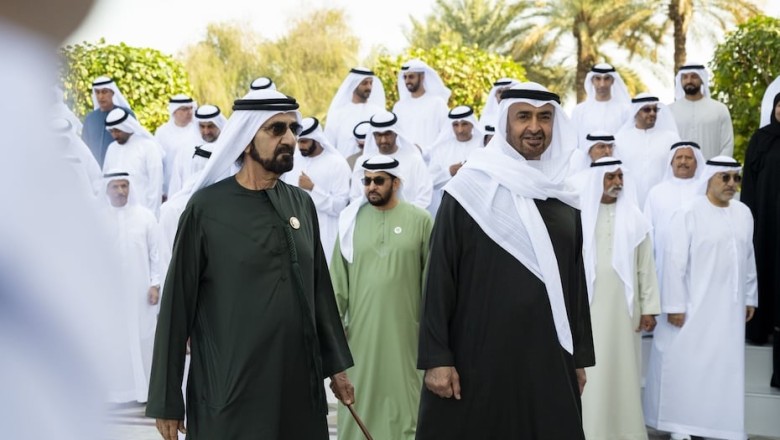

Leaders, including UAE President Sheikh Mohamed bin Zayed Al Nahyan, gathered over the weekend to mark the milestone
Twenty years ago this week, H.H. Sheikh Mohammed bin Rashid Al Maktoum became the Ruler of Dubai, marking the start of a period that would redefine federal governance and accelerate the emirate’s rise as a global hub.
On 4 January 2006, Sheikh Mohammed assumed the role of Ruler of Dubai. He became Prime Minister of the UAE shortly thereafter in February 2006.
READ MORE: From humble beginnings to global heights: Sheikh Mohammed’s journey unveiled in new biography
The milestone was marked over the weekend at a high-level meeting attended by UAE president Sheikh Mohamed bin Zayed Al Nahyan, alongside current and former ministers who have served in the UAE Government since 2006.
Congratulating Sheikh Mohammed, UAE president Sheikh Mohamed bin Zayed described the UAE Government as an inspiring model of development that places people at the heart of its priorities, guided by a vision aligned with the future aspirations of Emiratis.
For Sheikh Mohammed, the anniversary is a moment of reflection.
“Today, we mark 20 years since I assumed the office of Prime Minister — two decades spent working alongside a dedicated team that has given its utmost to this nation,” he said.
“In the life of a nation, 20 years may not be a long time, but the UAE has given this period a significance as vast as its achievements.”
That journey, he said, saw the UAE transform “in record time” from a regional leader into a global force, built on a development model centred on quality of life, human empowerment, a resilient economy and exceptional government efficiency.
“We were determined to be at the forefront of development to ensure a high quality of life, stability, progress and prosperity for the UAE and its people,” Sheikh Mohammed said.
“Today, we rank at the top of several fields, and the UAE has become a whole world within one country.”
He paid tribute to long-standing members of his leadership team, thanking Sheikh Mansour bin Zayed Al Nahyan, Sheikh Saif bin Zayed Al Nahyan and Sheikh Abdullah bin Zayed Al Nahyan for their roles over the past two decades, while also pointing to the next generation of leadership, including Sheikh Hamdan bin Mohammed in defence and Sheikh Maktoum bin Mohammed in finance.
“The people of the UAE love being number one,” Sheikh Mohammed said. “Our President aims for us to be number one by desiring the best for us. We in the UAE government are determined to realise this vision, as our people deserve the best.”
He added: “Twenty years have passed so swiftly, and the next 20 will also pass in this manner. However, we must all strive to leave a mark — one that drives our nation forward and endures the passing of time. Our best years are yet to come.”
Sheikh Mohammed’s two decades of leadership can be traced through a series of defining milestones that reshaped Dubai’s economy, institutions and global standing.
Over this period, Dubai’s economic scale and international relevance expanded sharply.
Since 2006, the emirate’s economy has more than doubled in real terms, its population has grown from around 1.3 million to more than 3.6 million.
Dubai has consistently ranked among the world’s leading cities for trade, tourism, aviation and foreign investment, underpinned by a governance model focused on speed, diversification and long-term planning.
Listed below are just some of the key achievements over the last two decades.
2006–2010
The period is marked by rapid infrastructure expansion across aviation, transport and real estate. Dubai International Airport accelerates its rise as a global hub, while large-scale urban development reinforces Dubai’s role as a regional business and tourism centre. In 2009, the Dubai Metro officially opens too.
2010
The inauguration of Burj Khalifa becomes a defining global moment, symbolising Dubai’s ambition and confidence.
2011–2015
Economic diversification gathers pace. Dubai’s GDP reached approximately Dhs389bn by 2014, driven by trade, tourism, transport, financial services and real estate. The emirate strengthens its position as a global trading hub, supported by world-class ports, logistics and aviation infrastructure.
2016–2019
Dubai intensifies its focus on future readiness. Smart government initiatives, digital services and innovation frameworks are rolled out, while long-term strategies reinforce competitiveness. By 2019, Dubai International Airport is handling more than 86 million passengers a year, making it consistently the world’s busiest airport for international traffic.
2020–2021
Despite global disruption caused by Covid-19, Dubai maintain momentum. Expo 2020 Dubai, held from October 2021 to March 2022, attracted more than 24 million visitors.
2022–2024
Dubai’s post-pandemic recovery is swift. GDP reaches Dhs429bn in 2023, growing more than 3 per cent year on year, led by transport, trade, tourism and financial services. Tourism rebounds strongly, with 17.15 million international visitors in 2023, surpassing pre-pandemic levels.